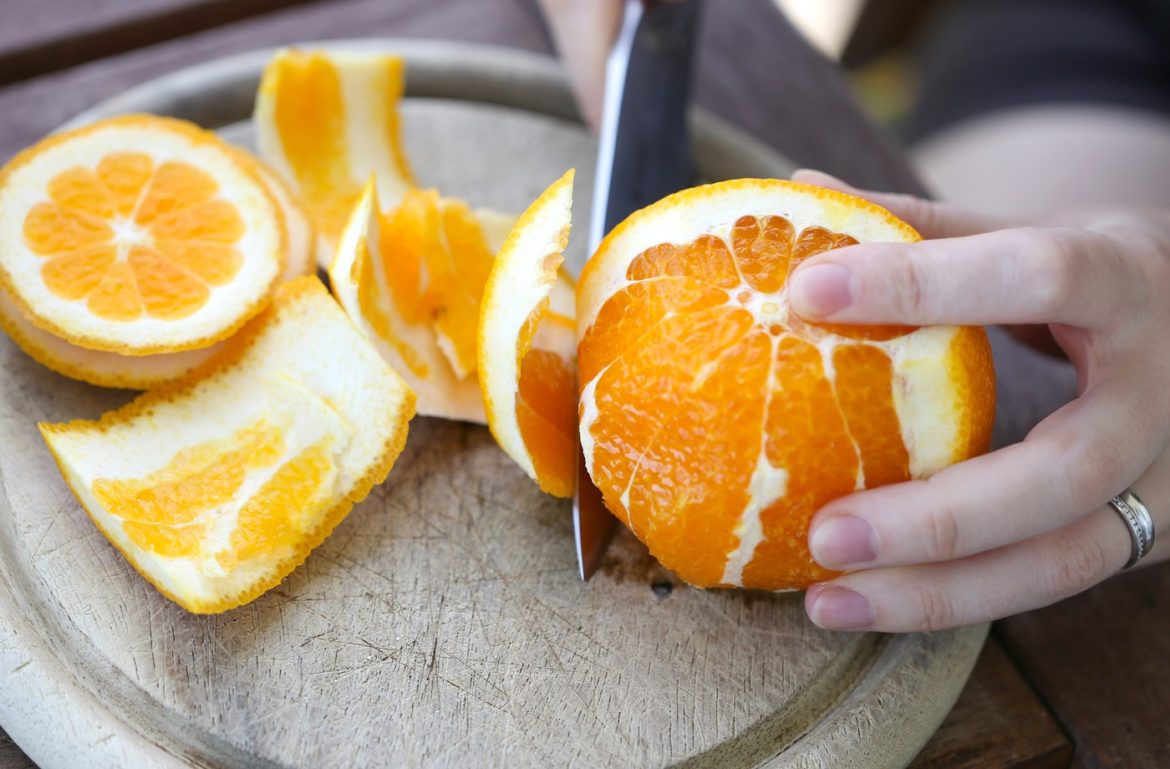
September 28, 2018 at 06:12AM Finding a new batch of in-season produce at the farmer’s market is just one more thing to love about PSL-weather. But next time you’re hygge-ing it up with a knit blanket, Netflix, and a bowl full of clementines, don’t toss those aromatic peels into the compost pile: Turns out, there’s a simple way to upcycle them into a multipurpose cleaner that will help keep your space looking and smelling fresh ’til spring. Apart from your leftover citrus rinds, you’ll need a mason jar (because, duh, this is DIY) and vinegar—a deodorizing agent that’s high acidity dissolves soap scum and brines like a champ, according to the The Kitchn. Next, all you have to do is drop the orange peels into the container along with the vinegar, and go about your business for a week, instructs Insider. After letting the peels marinate, you’ll have a tidying concoction that’s more Eau de Tuscany than Eau de Acidity. So pour the mixture into a spray bottle, and put it to work cleaning your wooden floors, mirrors, windows, and other non-stone surfaces (which the solution can actually scratch). Just note: The Centers for Disease Control and Prevention (CDC) doesn’t classify vinegar as a disinfectant, so you’ll want to pair it with a standard, store-bought cleaner for heavy-duty sprucing endeavors. Once you’ve spritzed your abode with the citrusy scent, all that’s missing is a batch of healthy pumpkin fudge. Welcome back, fall. When you do clean your mirrors and windows, use *this* instead of paper towels
Category: Vegetarians
Bookmark this list of the best sources of zinc before cold and flu season starts
September 27, 2018 at 10:37AM It’s not quite cold and flu season. (Phew!) Still, now’s the best time to get proactive with your health. This means scheduling a flu shot at the optimal time. It also means stocking up on immunity-boosting foods, making ginger tea, and soaking up as much vitamin D as you can. Another game-changer when it comes to not getting sick is zinc. Although it’s best known as an active ingredient in natural sunscreens. It’s also the fastest way to cure a common cold, according to science. Zinc should also be a regular part of your diet year-round—8 milligrams a day for women, 11 milligrams a day for men. That’s because your body doesn’t store it like it does other nutrients or enzymes. Zinc supplements exist. They can help clear up acne and balance a vegan diet when taken regularly. But it’s also possible to increase your zinc through your diet. Keep reading for the benefits of getting enough zinc. Plus, find a list of foods that are excellent sources of zinc, below. 5 health benefits of zinc 1. Zinc supports your immune system The human body needs zinc to grow and develop. A deficiency in the trace element can compromise your immune system. Read: Make you more susceptible to getting sick. 2. Zinc combats common colds Zinc has antiviral properties that can stop or slow down the bacteria that cause the flu and colds when consumed within 24 hours of symptom onset. It’s like your own slo-mo filter
How your microbiome can clue you in on the most effective way to lose weight
September 27, 2018 at 08:38AM In some circles, September is considered to be a second January, aka another shot at resolving to curb or enhance various behaviors in order to achieve your goals. One such resolution may, for some, include healthy weight loss—you know, the kind that focuses on diet rather than dieting and reasonable levels of targeted physical activity—and it’s not uncommon for this to become a frustratingly evasive unicorn to chase. Sometimes, no matter what you do, you cannot shed a single lb. But why? Of course, there are many reasons your weight may stay stubbornly stuck. One, however, is quickly becoming a central player not just within this conversation but in dialogues around a broad spectrum of health questions: your gut microbiome. It turns out, there is a relationship between weight loss and the 100 trillion bacteria living within your digestive tract. Status: It’s complicated. When I call Emeran Mayer, Ph.D, author of The Mind-Gut Connection and Professor in the Departments of Medicine, Physiology, and Psychiatry at UCLA, he says that research is still in the early stages, but explains what scientists know so far. First, he describes a couple of studies used to prove a connection. In one version, lean, germ-free mice raised in sterile environments were transplanted with bacteria-rich feces from genetically-modified obese mice with voracious appetites. They not only gained weight but also developed the same uninhibited food intake as a result. A similar experiment was done with fecal material taken from obese humans and transplanted into lean, germ-free
4-ingredient pumpkin fudge is the legit-healthy answer to your basic-fall-treat prayers
September 27, 2018 at 06:16AM With fall in the air, whipping up at least one seasonal treat is kind of required in order to get into peak autumn mode. (There’s no law to mandate the baking sesh, but, y’know what? There totally should be.) Don’t rush off to your go-to organic grocer just yet, though: Instead of filling your cart with a long list of ingredients, why not try out a pumpkin-fudge recipe that only requires four items that you probably already have in your pantry? And the recipe’s simplicity isn’t even its best feature: It’s also legitimately healthy. Amanda Meixner, the healthy food blogger behind the popular Instagram account @MeowMeix, recently shared a recipe for healthy pumpkin fudge that’s so easy to make, you should prepare yourself to re-create it all season long. The only things you need in order to whip up the satisfying dessert—which just so happens to be both Paleo-compliant and vegan—is 1/2 cup canned pumpkin (AKA you can finally put those leftovers to good use!), 1/2 cup creamy almond butter, 1/2 cup coconut oil, and 1/4 cup maple syrup for some natural sweetness. View this post on Instagram Fall is here and that means pumpkin everything! Give yourself a healthier a fall treat with this easy, peasy 4-ingredient pumpkin paleo fudge! . What you need: (Makes about 10 small pieces) 1/2 cup canned pumpkin 1/2 cup creamy almond butter 1/2 cup coconut oil 1/4 cup maple syrup . What to do: Step 1 – Pour all ingredients
Ancient super-ingredient tahini is now popping up in *all* the foods—but is it healthy?
September 26, 2018 at 11:11AM When the internet deems a certain superfood “cool,” it follows that foodies everywhere will start dreaming up ways to pack the newest darling into meals both sweet and savory. (Case in point: The avocado craze has officially breached even baked goods.) So when I noticed sesame-seed-derived tahini—a tan condiment that’s a mainstay in Mediterranean and Middle Eastern cuisine—starting to play the food-course field (sorry, hummus), I found myself experiencing Jonathan Van Ness–levels of curiosity. Why is this seed butter worthy of oatmeals, quinoa bowls, and desserts alike? Its benefits must be pretty great. The first reason is the flavor. The sesame derivative has a robust, slightly bitter taste that’s just as rich as your standard almond or peanut butter. This trait allows the ingredient to stealthily disguise itself in, well, just about anything. And second, tahini is dairy-free, keto-compliant, and packed with nutrients. (More on that below.) Basically, it’s a versatile yet nutritious powerhouse. Check out 3 reasons a tablespoon of tahini can boost vegan mac and cheese and ice cream alike. View this post on Instagram what vegan pasta dreams are made of a sauce I truly will never get sick of: dairy free tahini mac. so simple and goes well with basically any pasta/veggie/protein combo. my go-to meal after a busy day. recipe below! _____________ I made a double batch, but you can cut this in half for 1-2 servings: 1/4 cup tahini 1/4 cup plain, unsweetened almond milk (hemp or coconut milk for nut
Found: The healthiest way to cook your veggies in the microwave
September 26, 2018 at 09:33AM Although your Pinterest board may be a virtual gallery of intricate, mouth-watering recipes, your weekday dinners might look more microwave-ready than Michelin. But the good news is twofold: One: It’s a total myth that zapping your food makes it less healthy. Two: There’s a simple way to make sure your on-the-fly side of broc retains the most nutrient-density possible. According to Whitney Linsenmeyer, RD, PhD, a registered dietitian and spokeswoman for the Academy of Nutrition and Dietetics, steaming your veggies is the way to go, CNN reports. Why? Because both speedy cooking times (for which the microwave is king) and steam cooking have been found to preserve the most nutrients possible. Meaning, prep methods like boiling could strip the vitamins and minerals in your Brussels more than simpler cooking options. To hone your snappy side dish skills, just follow Linsenmeyer’s simple instructions: “You can use a microwave steaming tray with water in the bottom, or simply add your vegetables and a small amount of water to a microwave-safe bowl and cover with microwave-safe plastic wrap, leaving one corner open to allow air to escape,” she recommends. If you notice that there’s extra water remaining even after the microwave timer dings, she suggests saving the liquid as a flavorful “stock” that you can use as the foundation for future cozy soups. Just like that—dinner is served. Now that you’re putting your microwave to good use, make sure you’re cleaning it on the reg as well. And if you’re not already using the
These 3 foods are *the worst* for your metabolism, according to Jillian Michaels
September 26, 2018 at 09:20AM When you take a look the ingredients that rev up your metabolism, a few stand out. Namely, fiber (particularly from “real” foods like fruits and veggies) and iodine-rich options like seaweed. For every metabolic superhero, though, there’s an alternative eat out there that works the opposite way, sabotaging your body’s calorie-burning prowess. “The two things that are predominantly in control of your metabolism are your endocrine system and your hormone balance,” says Jillian Michaels, creator of the My Fitness app and former trainer on The Biggest Loser. Thus, when you chow down on something that disturbs these things, your metabolism gets thrown for a loop, too. You may have already guessed some of the nutritional villains that Michaels names as the worst for your metabolism—cough, sugar, cough—but below you’ll get the full scoop from the celeb coach herself, with a bit of added insight from nutrition experts. Keep reading to find out which foods you should avoid for a healthy metabolism. Photo: Unsplash/Joanna Kosinska 1. Sugar Not-so-shockingly, Michaels names sugar as one of the greatest culprits of a sluggish metabolism. Why? After savoring a dessert, she explains, your blood sugar spikes. This causes your cortisol and insulin hormone levels to increase, in an effort to level things out—and it can eventually lead to metabolic disruption if left unchecked long-term. “Hormones work in a symphony, and there are tons of them,” explains Michaels. “So ultimately, when we’re looking at metabolism, we want to make sure that we have the right hormones working for
15 healthy hotspots to checkout next time you’re in Atlanta
September 26, 2018 at 04:30AM If you’re looking for the perfect mix of Southern hospitality and incredible food, Atlanta’s got you covered. As home to one of the busiest airports in the US, chances are good you’ll find yourself in the ATL at one point or another—and if you’re planning to see more than the airport while you’re there, you’re going to need to know where to get your wellness fix. A-town is in the midst of a boutique fitness boom, with some of the nation’s buzziest new studios opening their doors within its city limits. And while the notoriously car-centric town is still pretty dependent on its vehicles, there’s plenty of space to bike, run, and scooter underneath the country’s densest urban canopy, too. Coupled that with a culinary scene that’s adding more and more clean-eating establishments to its offerings, plus some pretty unique entertainment options (ping-pong emporium, anyone), and start to get a sense of what makes the place so charming. Planning a trip to the ATL? Keep reading for a city guide of Atlanta’s healthiest places to sleep, eat, and play. View this post on Instagram Thinking about the weekend like A post shared by Hotel Clermont (@hotelclermont) on Aug 9, 2018 at 10:49am PDT //www.instagram.com/embed.js Good Sleep Hotel Clermont It’s been a rocky road for Hotel Clermont. Once a swanky motor lodge, the 95-year-old building had fallen into serious disrepair—so much so that it was shuttered by county inspectors in 2009. Now under new ownership, it
Everyone in LA is taking sulfur supplements—should you, too?
September 25, 2018 at 11:51AM Recently, while at a dinner with some of my most wellness-obsessed (and woo-woo-leaning) friends, the topic of sulfur supplementation arose. Thrilling, I know, but everyone at the table was apparently devoted to the practice… except for me. Intrigued by the claims my friends were making—not the least of which was that sulfur can combat cancer, though it’s also purported to help prevent diabetes, contribute to glowing skin, and aid in pain relief—I decided to investigate. Sulfur, as it turns out, is a pretty big deal. “It’s the third most common element in the body,” says renowned heart surgeon and inflammation expert Steven Gundry, MD. “Sulfur is so important that many theorize that on some other planet, a sulfur-based life form (as opposed to our planet’s, which is carbon-based) could exist.” Impressive, but what do our bodies actually do with it? Quite a lot, says naturopathic doctor Amy Chadwick, ND, who practices at OM-cinita’s Four Moons Spa. “The body uses sulfur to support blood vessels, joints, and the digestive tract lining,” she says. “Sulfur also plays a role in the pathways that break down hormones and neurotransmitters.” Importantly, she says, sulfur is also necessary for making glutathione, the body’s primary intracellular antioxidant. “[Glutathione] helps the cells get rid of their garbage, which allows for healthier cell communication and reduces cell damage,” she explains. “The cells of the body keep each other healthy through feedback and signaling, but when communication becomes disrupted, cells become isolated.” This is a contributing
I tried the ketogenic diet to help with my anxiety—here’s what happened
September 25, 2018 at 07:50AM When you’ve had anxiety most of your life like I have, you’re familiar with all the tricks. Meditation, essential oils, probiotics, wine…I’ve tried it all. And while I’ve mastered some tools for feeling better in the moment (deep belly breaths do actually work, it turns out), nothing has been 100 percent effective in preventing the anxious feelings from rising up in the first place. Not everyone with anxiety experiences it the same way—or for the same reasons. Sometimes, I don’t even know why I’m feeling anxious. I just am. Other times, like if public speaking is involved, it’s almost a given that my heart will race and my stomach will feel queasy. As Well+Good’s food editor, I’m well aware of the mind-gut connection and that certain foods can boost your happiness levels. But experiencing anxiety isn’t quite the same as feeling depressed (though the two are often coupled). Recently, I’ve noticed that scientists are linking the high-fat, low-carb ketogenic diet to the treatment of certain psychological disorders including depression and anxiety, but also bipolar disorder, schizophrenia, and attention deficit hyperactivity disorder (ADHD). That seems pretty darn powerful, right? So besides being the diet of choice for Vanessa Hudgens, Adriana Lima, and yes, even Kim Kardashian, the mental health benefits were enough to really intrigue me. I decided to commit to the ketogenic diet for a month to see if I noticed a difference in my body and mood. Can the ketogenic diet ease anxiety? Keep reading to find out. Photo: Stocksy/Michela Ravasio Meeting the nutritionists